 Phone: +8618330222305
 Email: sales08@bdhuazheng.com


Phone: +8618330222305
Email: sales08@bdhuazheng.com
Time: 2026-05-12 Author: 铧正 Click: 63 Time
For decades, DC hipot was the default way to acceptance-test a new MV cable run. It was cheap, the gear was light, and nobody had a better option. Then utilities started pulling failed XLPE cables out of the ground a few months after a clean DC test, and the industry slowly figured out what was going on. Today, if you're testing extruded dielectric cable — XLPE, EPR, TR-XLPE — VLF at 0.1 Hz is the right tool, and IEEE backs it up.
Here's the short version of why.
When you apply DC to a service-aged XLPE cable, charges get trapped inside microscopic water trees in the insulation. The trees themselves form over years from moisture and contaminants — totally normal in any cable that's seen a wet trench. What's not normal is what happens after you remove the DC test voltage: those trapped space charges sit there, distort the local field, and accelerate breakdown once the cable goes back into AC service.
EPRI's field research, summarized in IEEE 400-2001 and reaffirmed in IEEE 400.2, puts it bluntly: testing wet-aged XLPE with DC at the historically recommended levels can cause cables to fail after they return to service. That's the opposite of what an acceptance test is supposed to do.
VLF testing is still AC — the polarity flips every half cycle, so no space charge accumulates. At 0.1 Hz, the capacitive stress distribution inside the insulation closely matches what the cable sees on a 50/60 Hz grid. You're stressing the dielectric the way real life will, just slowly enough to keep the charging current and power supply manageable.
Practical upsides on the bench:
Lower test voltage, same detection. VLF spots insulation damage at roughly one-third of the equivalent DC voltage, so you stress the cable less to find the same defects.
Diagnostic-friendly. Tan delta and partial discharge measurements only work on AC. Pairing VLF withstand with TD and PD lets you grade the cable, not just pass/fail it.
No long bleed-off. After a DC test, crews often have to ground the cable for hours to drain trapped charge before re-energizing. VLF lets you put the cable back in service almost immediately.
DC hipot isn't dead. It's still fine for short paper-insulated cables (PILC), oil-filled cables, and basic insulation-resistance checks on dry switchgear. Just keep it away from any extruded-dielectric run that's been in the ground more than a year or two.
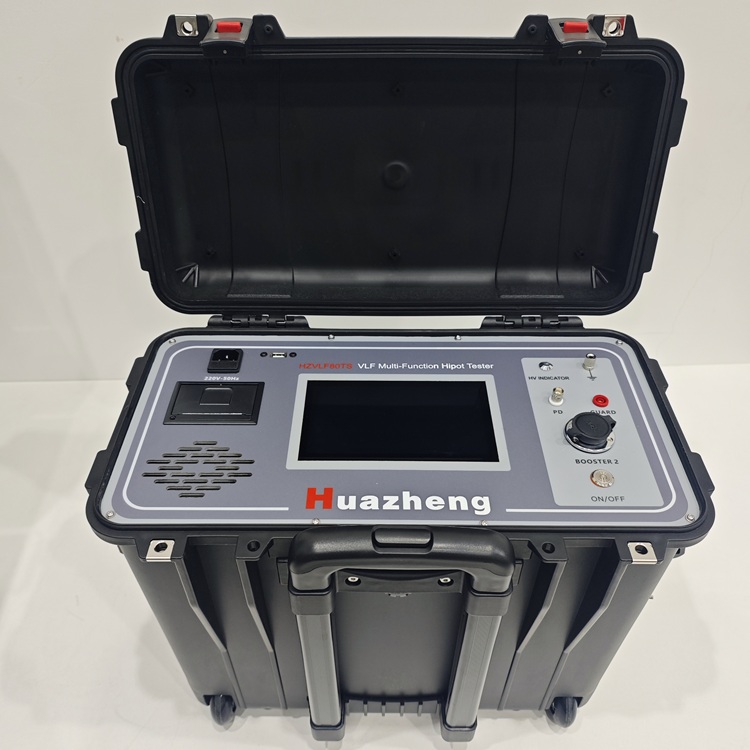
For XLPE acceptance and maintenance testing under IEEE 400.2, 0.1 Hz VLF is the modern standard. A combined VLF + TD + PD multi-function system gives you the withstand test and the diagnostic data on the same trip — no second visit, no second instrument.
![[sort:name]](/static/upload/image/20231109/1699520298738135.jpg)
 +8618330222305
 +8618330222305
 sales08@bdhuazheng.com
 0086-18330222305
 Julia Jin-huazheng
