Most transformer failures don't happen on the day of the fault. They happen months later, after a short-circuit current has already weakened the winding geometry and nobody noticed. This delayed-failure pattern is the reason **sweep frequency response analysis (SFRA)** has moved from research labs into routine substation diagnostics over the last decade.
The principle is straightforward enough once you see it. A transformer winding is, electrically speaking, a complex network of distributed inductance, capacitance, and resistance. When the physical geometry shifts — even by a few millimeters — those distributed parameters change, and so does the transfer function. SFRA captures that transfer function across a wide frequency band, typically **10 Hz to 2 MHz**, and presents it as a magnitude-versus-frequency curve.
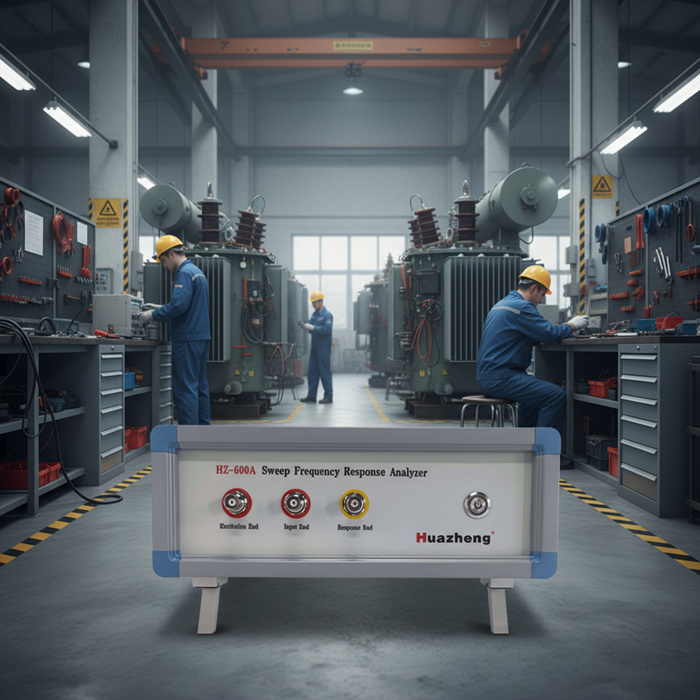
What field engineers actually look for is deviation. Three comparison methods are standard practice. Time-based comparison sets today's trace against a fingerprint recorded when the unit was commissioned. Phase-based comparison checks A-phase against B and C on the same transformer. Type-based comparison pulls in data from a sister unit of identical design. Any one of these can flag axial displacement, radial bulging, hoop buckling, or telescoping — defects that used to require lifting the active part out of the tank.
A few practical points worth knowing. The test runs offline, with the transformer fully de-energized and grounded straps removed at the connection point. Each winding takes one to two minutes. Output impedance of the source sits at 50 Ω, and a 5000 V isolation barrier between the test channels and the laptop protects the operator's computer from any residual charge in the transformer.
Interpretation is where experience matters. The DL/T 911-2016 standard gives correlation-coefficient thresholds for the low-, medium-, and high-frequency sub-bands, but the numbers alone don't tell the whole story. A correlation drop in the 100 kHz–1 MHz band almost always points to localized winding damage. A shift below 10 kHz, on the other hand, usually means the core itself has moved — sometimes during transport, sometimes after a violent fault.
Pair SFRA with short-circuit impedance measurement and winding DC resistance, and you have a diagnostic stack that can confirm or rule out mechanical damage without ever opening the transformer. For utilities managing fleets of aging 110 kV and 220 kV units, that confirmation is worth the price of the analyzer many times over.
 Phone: +8618330222305
 Email: sales08@bdhuazheng.com


![[sort:name]](/static/upload/image/20231109/1699520298738135.jpg)
 +8618330222305
 +8618330222305
 sales08@bdhuazheng.com
 0086-18330222305
 Julia Jin-huazheng
