 Phone: +8618330222305
 Email: sales08@bdhuazheng.com


Phone: +8618330222305
Email: sales08@bdhuazheng.com
Time: 2026-08-27 Author: 铧正 Click: 104 Time
A DC hipot still rides along on a lot of cable jobs. On service-aged XLPE or EPR, that is the wrong tool. Direct voltage parks space charge at water trees and shield interfaces; when the feeder goes back on AC, that leftover field can finish a defect the test was supposed to find. IEEE 400.2 is not vague here. For shielded medium-voltage cable, the field source that belongs on site is a very low frequency AC hipot, not DC.
A VLF multi-function hipot tester with tan delta is the practical answer to that standard. One hookup supplies 0.1 Hz down to 0.01 Hz, holds the circuit at the IEEE withstand level, and reads dielectric loss, capacitance, and insulation resistance without a separate bridge. You still get a pass/fail. You also get a number you can trend.
Tan delta is just the ratio of resistive current to capacitive current. Healthy XLPE looks almost purely capacitive. Moisture, water trees, and corroded shields push the resistive part up. A single reading at U0 is useful. Tip-up — tan δ at 1.5 U0 minus tan δ at 0.5 U0 — plus the standard deviation while you sit at U0, is usually more honest. A cable that is quiet at half voltage and noisy at 1.5 U0 is telling you something a megger will never show.
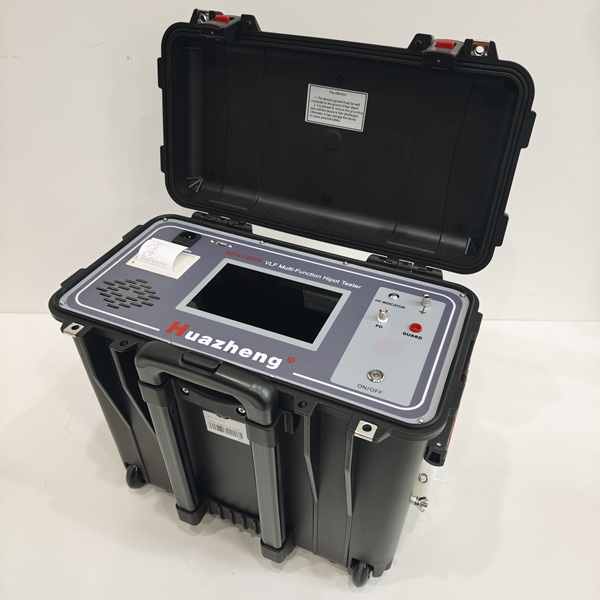
On the HZVLF series that measurement runs from 1 kV to rated voltage. The tan delta window is 0.01×10⁻³ to 655.35×10⁻³, resolution 1×10⁻⁵, accuracy 1%. Capacitance covers 0.001 μF to 10 μF. Insulation resistance goes to 65535 MΩ. Voltage and current are sampled on the high-voltage side, closed-loop, so the output does not climb with load the way an open-loop generator can. Ground is interlocked: no earth, no boost.
The hardware is sized for what crews actually carry. A 40 kV peak all-in-one unit weighs 30 kg and takes ≤10 μF, with frequency dropping automatically as the cable gets longer — enough for most 10 kV class cable and motor jobs. 50 kV and 60 kV stay integrated (35 kg, 6 μF / 5 μF). 80 kV and 90 kV peak add a series booster for 35 kV class circuits. S models do VLF AC, DC, and dielectric loss. TS models add partial discharge, 0–10000 pC at 200 MHz. That pairing matters. Tan delta grades the whole length. PD finds the bad joint. Running both during a monitored withstand is how you stop treating every high tan δ as a full-circuit replacement.
If the insulation is XLPE or EPR, leave the DC set on the truck.

 +8618330222305
 +8618330222305
 sales08@bdhuazheng.com
 0086-18330222305
 Julia Jin-huazheng
