 Phone: +8618330222305
 Email: sales08@bdhuazheng.com


Phone: +8618330222305
Email: sales08@bdhuazheng.com
Time: 2026-10-30 Author: 铧正 Click: 11 Time
Most lab arguments about transformer core loss are not about the core. They are about the meter. IEEE C57.12.90 (and C57.12.91 for dry-type) still expects no-load loss and excitation current at rated voltage, 60 Hz in this market, with the other winding open. DOE’s uniform test method in 10 CFR 431 then takes those watts, corrects waveform when the supply is dirty, and refers no-load loss to 20 °C before efficiency is calculated.
Where benches fall over is phase angle. A distribution transformer on open circuit can present a power factor of 0.2, sometimes much worse on high-efficiency designs. If the wattmeter’s PF specification stops being honest there, the lab can “pass” a unit that a second lab fails, or the other way around. Auditors notice that. So do manufacturers who just lost a DOE-related shipment.
Record the two voltages, not only the watts
The average-voltage voltmeter method is still the backbone of the IEEE test code. One channel tracks average-responding, RMS-scaled voltage; another tracks true RMS. Harmonics push those two apart. Eddy-current loss in the steel follows RMS; peak flux — and hysteresis — follows the average. Without both, you cannot defend the sine-wave correction. A portable analyzer that also plots 1st-to-32nd harmonics and the actual voltage waveform saves the technician from dragging a separate scope onto the pad.
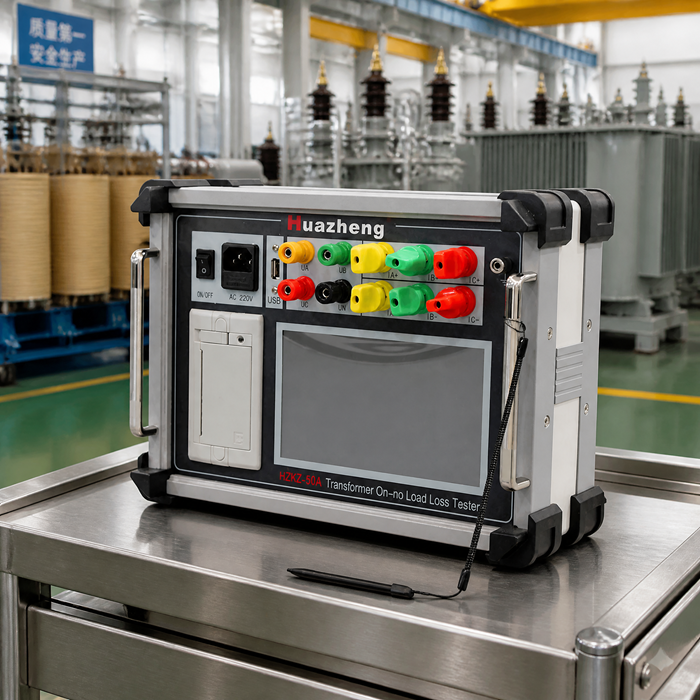
The HZKZ-50A Transformer No-Load Loss Measurement Equipment from Huazheng Electric puts voltage, current, angle and power next to a vector diagram on a 7-inch touch screen. Power accuracy is 0.2% from PF 1.0–0.2 and 1% from 0.2–0.01. Voltage and current sit at 0.1% across 40–70 Hz, so 60 Hz work is inside the rated band, not at the edge of it. Direct ranges are 10–500 V phase (850 V line) and 0.1–50 A; larger lab setups simply hang calibrated PT and CT on the inputs and type in the ratios.
Data the second lab can reopen
Independent labs live on repeatability. The HZKZ-50A Transformer No-Load Loss Measurement Equipment stores records in a DBF database, stamps them with its internal clock, and exports through USB in a form Excel will open. That is the file you attach to an ISO/IEC 17025 work order, not a handwritten wattmeter reading. Characteristic curves under no-load can be captured while voltage is raised, which is useful when a repaired core looks electrically “soft” only above 90% voltage.
The box itself is small enough to move between a climate-controlled bay and a customer’s factory floor. Supply is AC 220 V ±10%, 50/60 Hz; English interface; operating range −20 °C to 40 °C. Huazheng has been building power-test instruments since 2008, with CE and TUV marks and supply history into more than 100 countries. For a North American laboratory, the buying question is narrow: will this transformer no-load loss measurement equipment hold watts at low PF, show the waveform the IEEE code cares about, and leave an audit trail? On those three points, this analyzer is built to be the bench meter, not a toy.

 +8618330222305
 +8618330222305
 sales08@bdhuazheng.com
 0086-18330222305
 Julia Jin-huazheng
